A step-by-step, backyard-tested guide to securing your flock from foxes, raccoons, hawks, and digging predators using hardware cloth, aprons, and foolproof l...
The Cluck Loom
Automatic Chicken Coop Doors: Worth It or Not?
Automatic coop doors can be a game changer for busy chicken keepers, but they are not all built the same. Compare the main door mechanisms, power options, fail-safe behavior, and real-world pros and cons to choose one that works.

Maggie Harper
Maggie Harper is a passionate backyard chicken keeper with over a decade of hands-on experience raising mixed flocks. Through CluckLoom, she shares practical advice on coop building, flock health, and egg production to help beginners and seasoned enthusiasts alike raise happy, healthy chickens.
Published
October 22, 2026
Last updated
October 22, 2026
When I started keeping chickens, my “automatic coop door” was me, in slippers, sprinting into the yard at dusk because I lost track of time. It worked, until it didn’t. If you have ever bolted out of the house because you heard a weird bark, got stuck at work late, or realized you forgot to shut the coop on vacation, you already understand the appeal of an automatic chicken coop door.
Are they worth it? Often, yes. But only if you pick the right style for your coop and your predators, and you install it like you mean it. By “mean it,” I mean: mount it square so it cannot bind, protect the electronics from weather, and make sure you have a quick manual override for the night something goes sideways. Below is my real-world breakdown of the main mechanisms, what to look for, and what usually goes wrong.
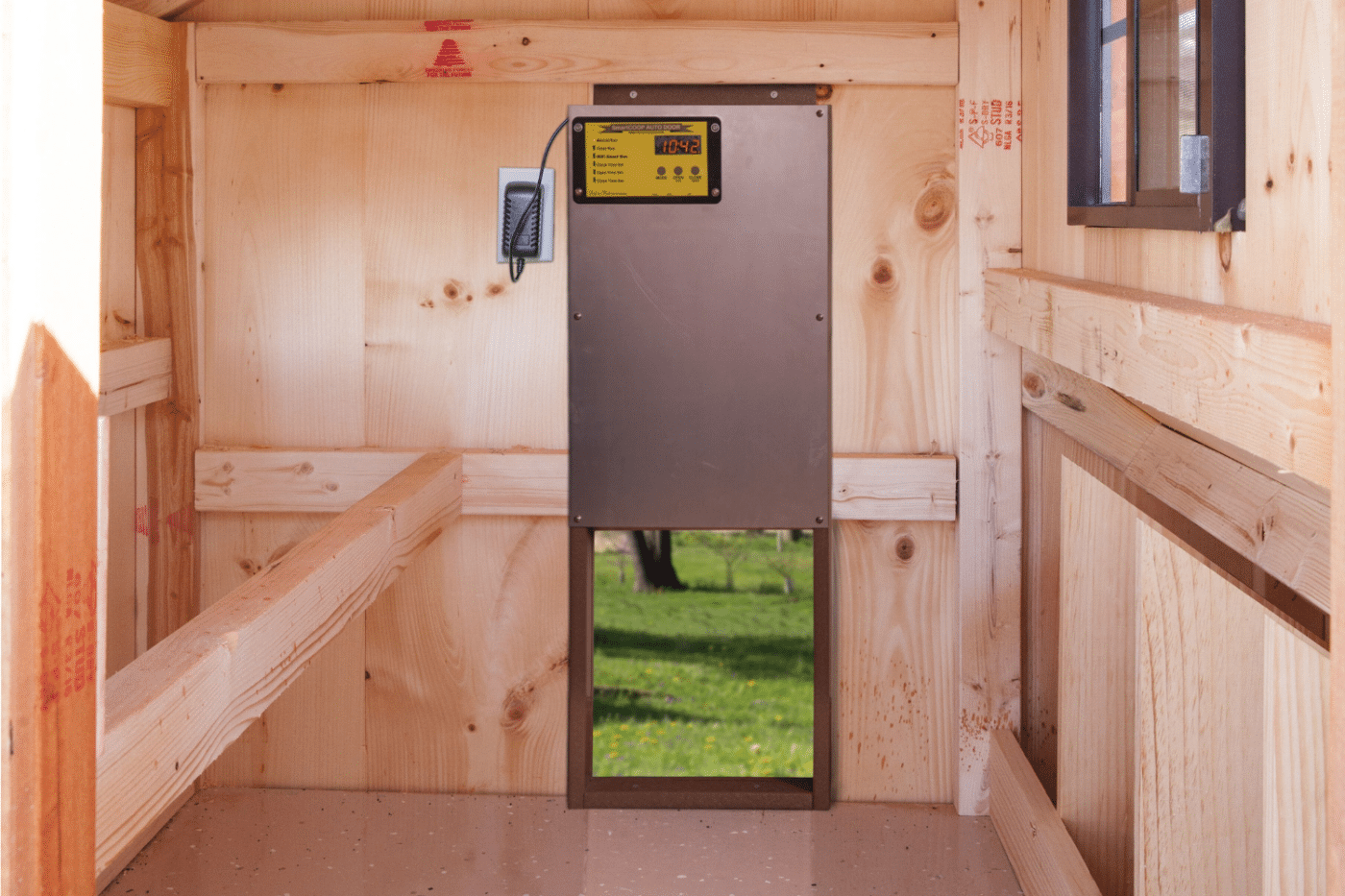
What it does (and does not)
An automatic coop door is a motorized opener that closes your pop door on a schedule (timer) or by light level (light sensor, sometimes called a photo sensor). The good ones are designed to:
- Close consistently at dusk even when you are not home
- Open in the morning so the flock can get to feed and water
- Reduce human error, which is a bigger predator risk than most people want to admit
What it does not automatically do:
- Keep raccoons from tearing apart weak hardware cloth, latches, or wood rot
- Replace a secure run or overnight predator-proofing
- Guarantee every chicken is inside (more on this in Common problems)
Door types
Most automatic coop doors fall into a few mechanism families. Think of these as the “engine type” of your setup. Two doors with the same price tag can perform very differently depending on how they move, how they sense resistance, and what happens during a power hiccup.
1) Vertical sliding doors
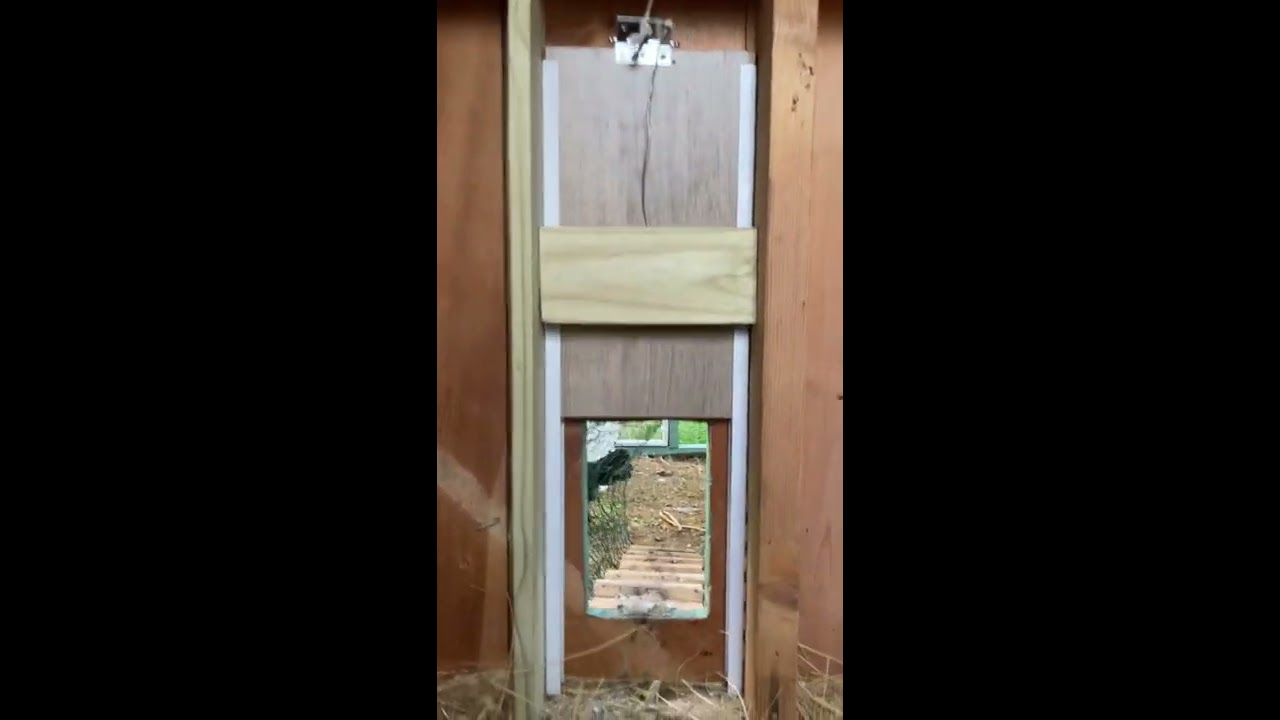
This is the most common style: a panel slides up and down in side rails. The opener raises it in the morning and lowers it closed at night (sometimes under motor control, sometimes aided by gravity, depending on the model).
- Pros: Simple, compact, fits many coops, easy to retrofit, tends to seal well against drafts if your rails are straight.
- Cons: Rails can bind with mud, ice, warped wood, or heavy bedding kicked into the track. If the unit relies on a gravity drop, you want solid anti-pinch behavior and good guides.
- Best for: Most backyard coops, especially wall-mounted pop doors.
If your coop wall swells and shrinks with weather, leave a little clearance in the rails. Too snug looks tidy until the first rainy week.
2) Swing doors
These open like a tiny people door, usually inward or outward with a motor arm.
- Pros: No vertical track to ice up; can work well where you cannot mount rails.
- Cons: Needs clear swing space. Wind can fight it. Predators can sometimes leverage a hinged door if the latch design is weak.
- Best for: Coops with sheltered entryways and good framing where a swing path stays clear year-round.
3) Spool and cable lifters
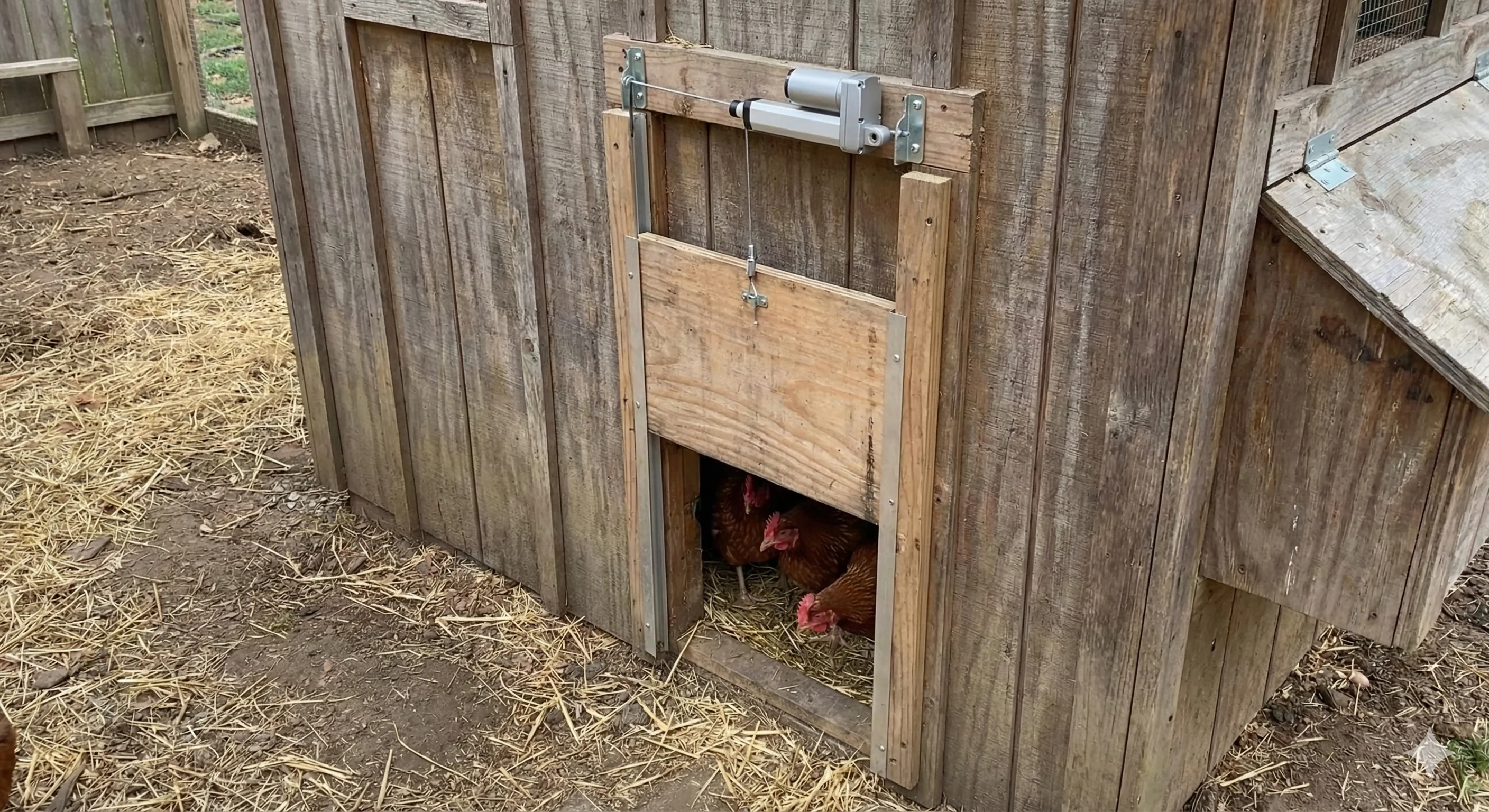
Some openers use a little winch that winds cable to lift the door, then unwinds to lower it.
- Pros: Flexible mounting locations, can lift heavier doors, replacement parts are sometimes straightforward.
- Cons: Cables can fray, jump the spool, or tangle if not aligned. If a cable breaks, you need a manual backup plan that night.
- Best for: DIY builders who are comfortable checking alignment and tension a few times a year.
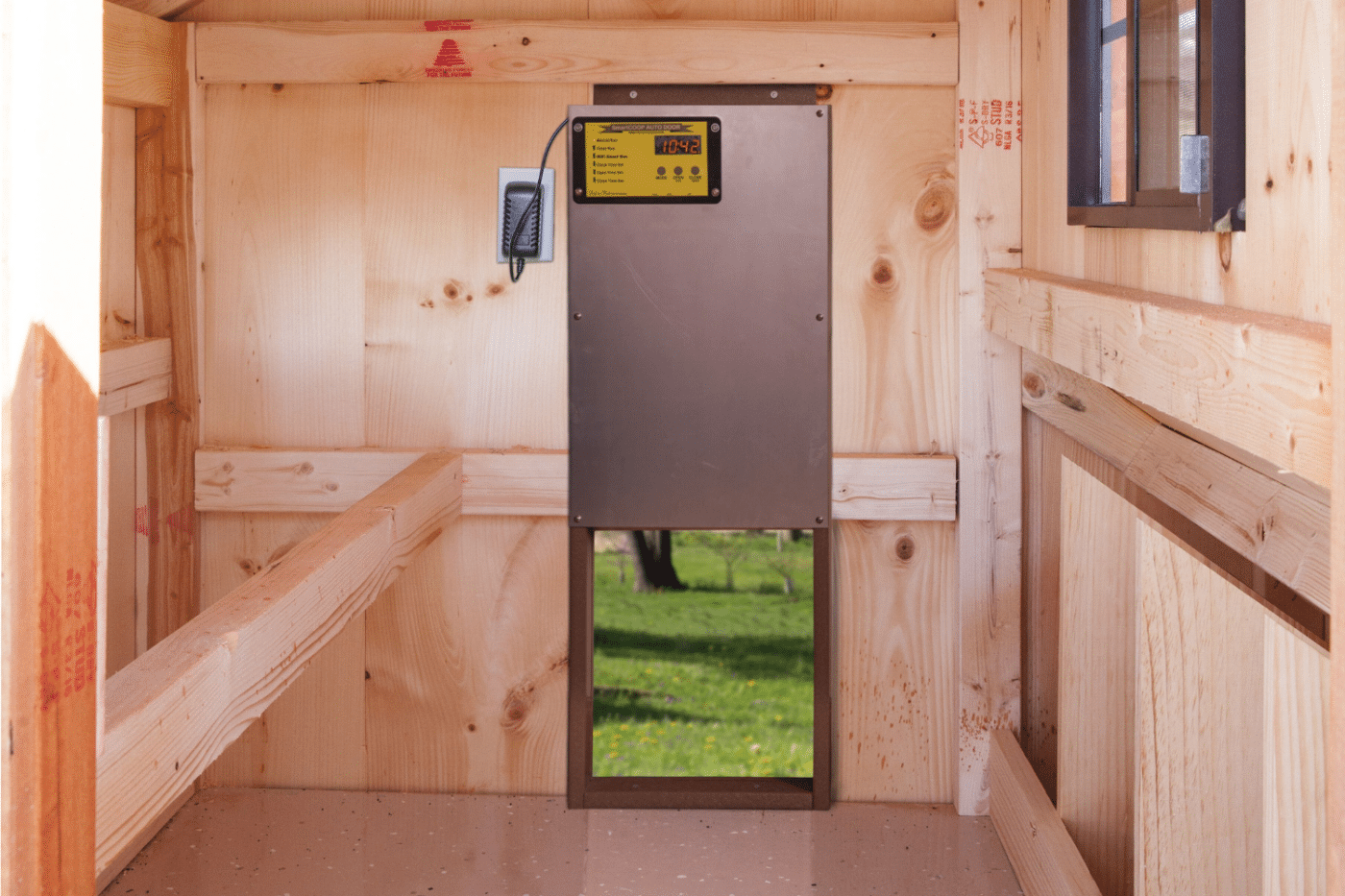
4) All-in-one door units
These come as a complete framed door with the motor and controls built in.
- Pros: Easiest to install cleanly, fewer “mystery compatibility” issues, often better weather sealing.
- Cons: More expensive, and you need the framed opening size to match your coop.
- Best for: New coop builds, or keepers who want the least fiddling and a tidy install.
Controls: timer vs light sensor
Timer-only
You set open and close times. Simple and predictable.
- Where it shines: Consistent routine, especially in winter when dusk is early and you want the door closed before prime predator hours.
- Gotcha: You must adjust it seasonally. If you forget, you will either close too early (someone gets locked out) or too late (welcome, raccoon).
Light sensor
The door opens at dawn and closes at dusk based on ambient light.
- Where it shines: Set it and forget it through seasonal daylight changes.
- Gotcha: Coop lighting, headlights, security lights, and even bright porch lights can confuse it. Heavy storm clouds can also trigger early closing.
Combo units
Many modern doors let you choose timer or light sensor, and some allow offsets (example: close 20 minutes after “dark”).
- Where it shines: Flexibility for real life, especially if you use a coop light in winter.
Power options
Battery-powered
Usually AA batteries or a rechargeable pack.
- Pros: No extension cords, safer around moisture, great for remote coops.
- Cons: Batteries die faster in cold snaps. You need a habit: check the battery indicator like you check feed levels.
Solar-assisted
Solar panel charges a battery pack.
- Pros: Less battery babysitting, excellent for off-grid coops.
- Cons: Winter shade, snow cover, and dirty panels can undercharge. You still need a backup plan for long cloudy stretches.
Plug-in
Hardwired or plugged into an outdoor-rated outlet.
- Pros: Very consistent, less worry about cold draining batteries.
- Cons: You must protect cords from chewing, tripping, and weather. Power outages still happen.
My practical rule: If you do plug-in, make sure the door can be operated manually in 10 seconds with a flashlight in your teeth.
Power loss and fail-safe behavior
Here is the spec most people forget to check: what the door does during a power loss or low battery event. Some units fail in place (it stays wherever it was). Some default open. Some try to close. There is no universal answer, so read the manual before you buy and decide what risk you can live with.
- If you have heavy night predators, a “stays closed” or “fails in place” outcome is usually preferable to “pops open.”
- Whatever you choose, make sure you can open and close it manually without tools.
What predator-proof really means
Automatic doors are often marketed as predator-proof. Some are. Some are simply “hands-free.” Here is what matters in the real world:
Door material
- Metal (aluminum or steel) can hold up well to chewing and clawing, especially when it is thick enough and supported by solid guides.
- Plastic can work, but I do not love it in high-predator areas.
Guides and framing
- Vertical doors need stiff rails so a raccoon cannot wiggle the panel sideways.
- The door opening should be framed solidly so predators cannot pry the coop wall itself.
Closing force and anti-pinch
You want enough strength to close reliably, but not so much that it hurts a bird. Look for doors that:
- Detect resistance and stop or reverse
- Close slowly rather than slam
- Allow a safety delay or warning beep (if you use that feature, keep it consistent so your flock learns the routine)
Manual lock (optional)
Some keepers add a secondary latch for extra security. I only recommend it if you can realistically use it every night, otherwise it becomes one more thing you forget.
Mechanism comparison
Instead of brand names (which change models constantly), I recommend choosing by mechanism and features that match your setup. Use this table as your “shortlist builder.”
| Mechanism | Reliability in bad weather | Install difficulty | Best fit | Common failure points |
|---|---|---|---|---|
| Vertical sliding, framed all-in-one | High (if mounted square) | Low to medium | New builds, clean retrofits | Battery drain in cold, misaligned frame |
| Vertical sliding, retrofit opener + your door | Medium to high | Medium | DIY keepers, existing doors | Binding rails, warped door panel |
| Spool and cable lift | Medium | Medium to high | Odd-shaped coops, heavier doors | Cable wear, spool misalignment |
| Hinged swing door | Medium | Medium | Sheltered entries | Wind interference, latch weakness |
Before you buy
1) Measure the opening
Measure width and height of the clear opening, and the flat mounting space around it. Many “universal” doors still need a certain amount of flat wall for screws and a weather seal.
2) Make sure your flock fits
Big fluffy breeds (hello, Orpington friends) appreciate a slightly taller, wider opening. If your hens have to duck hard, you will see hesitation at bedtime.
3) Plan for ice, mud, and bedding
- If your run is muddy, mount the bottom of the opening high enough that splatter does not cake into the rails.
- If you deep-litter inside, make sure bedding cannot pile into the doorway track
4) Mount it where it stays dry
Even “weather-resistant” electronics live longer under an eave or small awning. If your coop wall takes the full brunt of rain, consider adding a simple cover above the door.
5) Think through power
Battery and solar are easiest. If you are running AC power, use outdoor-rated equipment and protect cords in conduit where pets, rodents, and weed trimmers cannot get to them.
Pros and cons
Why it is worth it
- You have an unpredictable schedule. Late meetings and traffic happen. Chickens still go to bed.
- You are in a high-predator area. A door that closes on time every time can be the difference between “fine” and “devastating.”
- You travel. It reduces what a neighbor has to remember.
- You want steadier routines. Less nighttime disturbance and fewer “forgot to latch it” moments can help keep the flock calmer, which may support consistency over time.
Why you might wait
- Your coop and run are not secure yet. Spend money first on hardware cloth, buried apron, locks, and structural repairs
- You have chronic late stragglers. Some flocks need routine training before automation.
- Your opening is awkward. If installation will be a hacky fit, reliability usually suffers.
Good-fit scenarios
Busy families
If you are juggling sports practice, dinner, and homework, an automatic door is pure sanity. I call it the “no more twilight panic” upgrade.
Winter keepers
In winter, dusk can hit fast. Timer control can keep your girls safe when it gets dark at 4:30 pm and you are still commuting
Mobility limitations
Walking out on icy steps just to shut the coop is not a small thing. Automation can make chicken keeping more accessible and safer.
Common problems
“It closed on my hen”
This is the fear everyone has. Choose a door with resistance detection, and test it during the day using a rolled towel placed gently in the path. Also, avoid doors that free-fall or slam shut.
“It closed too early”
Most often this happens with a light sensor plus storms, shadows, or nearby lights. Solutions:
- Use a combo unit and switch to timer in stormy seasons
- Mount the sensor where it reads true outdoor light, not your porch light
- Set a “close delay” if your unit offers it
“It jammed halfway”
Usually rails are not perfectly plumb, the door is rubbing, or debris is in the track.
- Square the frame and rails with a level
- Keep the track clear of bedding
- In freezing climates, avoid mounting where meltwater refreezes in the rails
“Batteries died and I did not know”
Pick a unit with a clear low-battery warning, then put a recurring reminder on your calendar. I tie it to an existing habit, like the first Saturday of the month when I refresh grit and oyster shell.
Winter note
Cold weather problems are not just battery problems. Ice and condensation can make a perfectly good door act possessed.
- Keep rails and thresholds clear: kicked bedding plus melt-freeze cycles are a classic jam recipe.
- Watch for condensation: if the control box is exposed, moisture can creep in, then freeze.
- Do quick maintenance: brush tracks, check screws, and make sure the door still moves freely by hand.
Install checklist
- Pick the right door size for your largest bird, not your smallest pullet.
- Mount on flat, solid wood and repair any rot first.
- Use exterior screws and pre-drill to prevent splitting.
- Seal gaps around the frame so drafts and mice have fewer invitations
- Test manual operation before you trust the motor.
- Run 10 open/close cycles in daylight and listen for rubbing.
- Do a dusk test with the flock present, and watch how they behave.
So, is it worth it?
For most backyard keepers who care about consistency and predator safety, a well-chosen automatic coop door is worth it. You are not just buying convenience. You are buying reliability on the nights you are human, busy, forgetful, or stuck somewhere you cannot control.
That said, the door should be an upgrade to a coop that is already structurally solid. If your run is still chicken wire, or your latch is one clever raccoon away from disaster, start there. An automatic door cannot outsmart a weak coop.
Quick FAQ
Will an automatic door keep raccoons out?
It helps a lot, because it removes the “oops, I forgot to shut the coop” risk. But raccoons can still break into poorly built walls, weak vents, or flimsy runs. Think of the door as one strong layer, not the whole security system.
Is a light sensor or timer better?
If you use coop lights or have lots of shadows, timer is usually more predictable. If you want minimal seasonal adjusting and your sensor can read true outdoor light, a light sensor can be great. Combo units give you the most flexibility.
What if a chicken is outside when it closes?
This is why routine matters. Do a week of “treat them into the coop” at dusk so they learn the schedule. If you have chronic late roosters or explorers, choose a door with a closing delay and consider switching to a slightly later closing time.
How much should I expect to spend?
Prices vary widely by build quality and whether it is an all-in-one framed door. My advice is to buy the most reliable unit you can reasonably afford, because a cheap door that fails once at the wrong time can become the most expensive “deal” you ever brought home.